
Written by James Mislow, NRA CCW Instructor and CEO of Slim Fit Holsters.
Holster retention is what keeps your pistol secured inside its holster. Terms such as passive retention, active retention, and adjustable retention describe different parts of that function.
At Slim Fit Holsters, the retention system depends on the holster and configuration you choose. Here is how those terms apply to our lineup, including our Speed Hood Gen 2 Level II option.
Passive retention: how the molded shell holds your pistol
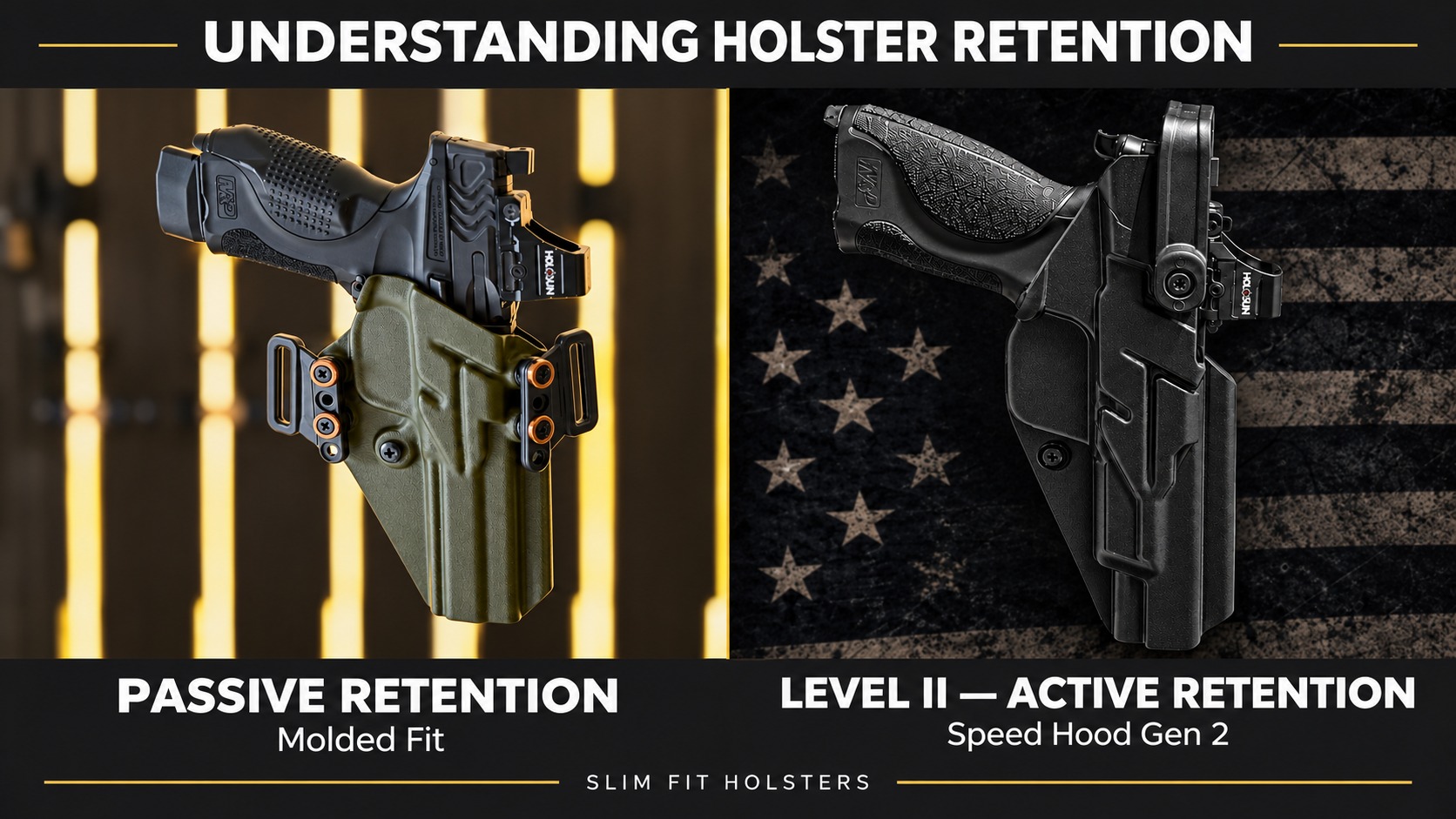
Passive retention uses the holster’s molded shape and contact with the pistol or weapon light to hold the setup in place. That can involve friction, a molded feature that the pistol settles into, or a combination of both.
The draw overcomes that resistance. There is no separate hood, button, or lever to release.
Our Phalanx AIWB, Carnex AIWB, Guard IWB, and Orbis OWB are examples of passive-retention holsters. Their carry positions and attachment systems differ, but their standard pistol retention comes from the molded shell fit rather than a separately operated hood.
How retention applies to our holsters
| Our holster | Carry style | How retention works |
|---|---|---|
| Phalanx AIWB | Appendix inside the waistband | The molded shell provides passive retention. Its concealment options help position the holster and pistol on your body. |
| Carnex AIWB | Appendix holster and magazine-carrier system | The pistol shell provides passive retention. The flex hinge lets the modules move with your body; it is not an active pistol lock. |
| Guard IWB | Inside the waistband | Adjustable passive retention lets you fine-tune the holding tension using the retention screw. |
| Orbis OWB | Close-to-body outside-the-waistband carry | The molded shell provides passive retention. The belt loops and optional Flex Mount manage how the holster sits and moves on your belt. |
| DDL OWB | Outside-the-waistband shell for a separate mounting platform | The optional Level II configuration adds our Speed Hood Gen 2 active retention hood. A DDL ordered without that hood relies on its molded shell fit. |
Outside-the-waistband does not automatically mean active retention. Our Orbis is an example of an OWB holster that uses passive retention. The DDL offers a hood option for customers who want a separate release mechanism.
Active retention: our Speed Hood Gen 2
Active retention uses a mechanical device that must be released before the pistol can leave the holster.
Our Level II holsters use the Speed Hood Gen 2. On a DDL ordered with the Level II option, the hood adds an active retention feature alongside the molded shell fit. The user must release the hood before drawing the pistol.
That is the practical difference between passive retention and our hood-equipped Level II setup: one relies on molded fit and resistance, while the other also requires operation of a release mechanism.
Slim Fit Holsters currently does not offer Level III retention. Retention-level definitions and testing methods vary, so evaluate the actual features and release requirements alongside any level designation.
Adjustable retention: changing the holding tension
Adjustable retention means you can change how tightly the holster holds the pistol. On an adjustable-retention setup such as our Guard IWB, the retention screw changes that holding tension.
Follow the instructions for your specific holster, make small adjustments, and evaluate its fit with an unloaded firearm.
Tightening a retention screw does not add an active lock or turn a passive-retention holster into a Level II holster. It adjusts the tension already provided by the shell.
Light-bearing retention
On our light-bearing holsters, the selected weapon light can serve as a primary retention surface. Because the holster is formed for that configuration, insertion and removal may feel different from a non-light-bearing setup.
Use the exact pistol-and-light combination selected for your holster. Do not assume that removing the light will leave the pistol properly retained.
What about the click?
Some molded holsters produce a noticeable click as the pistol seats. Others provide a firm, gradual fit. Sound alone does not establish retention quality or confirm that an active lock is engaged.
For your Slim Fit Holsters setup, focus on correct fit and consistent retention with the intended pistol and light.
Retention and concealment features serve different purposes
Clips and belt loops attach the holster to your carry setup. Wings and wedges help manage positioning and concealment. Flexible hinges and mounts allow movement between components.
Those features contribute to how the complete setup fits and functions, but they should not be confused with an active retention release.
When checking your holster, use an unloaded firearm, follow all firearm safety rules, and follow the instructions for your specific configuration. Contact Slim Fit Holsters if you need help identifying or adjusting your retention system.