Appendix Carry Draw and Setup
Drawing from the appendix position (AIWB) is one of the fastest and most efficient methods for concealed carry. Here’s how to execute it properly:
- Garment Clearing: Use your support hand to lift your shirt. Anchor that hand on your chest or high across your body like a “karate chop”—this keeps it out of the way and ready to meet your firing hand.
- Establishing Grip: Your dominant hand obtains a firing grip on the pistol while it’s still holstered.
- The Draw Stroke: Draw the firearm straight up, keeping it close to your body.
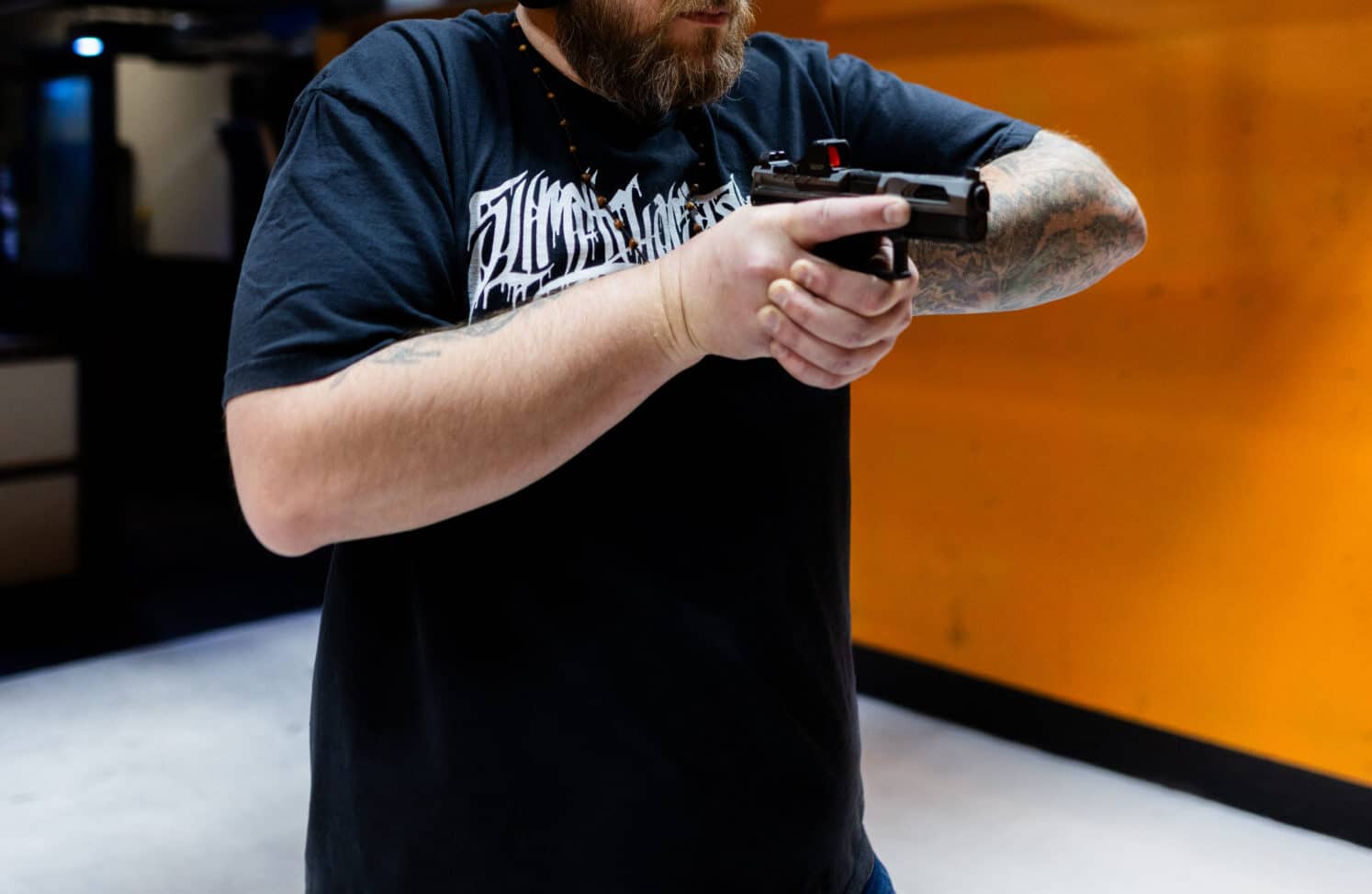
- Compressed Ready Position: As soon as the gun clears the holster, bring it to the center of your chest. Your support hand joins to establish a two-handed (Master) grip, forming a position known as “compressed ready.”
Compressed Ready Shooting
The compressed ready position is your base to shoot from if the threat is extremely close, or to transition from as you extend out.
- Elbows are tight to your sides pointed to the ground.
- The pistol is directly in front of your chest or sternum.
- The muzzle is angled toward the threat, and the gun is indexed by feel and body mechanics, not sights.
- Trigger finger stays indexed until you make the conscious decision to shoot.
- From the compressed ready position, you can transition the pistol into a SUL position—this is useful when you’re unsure of the situation but want to keep the gun pointed in a safe direction while remaining ready to engage if needed.
Engaging from this position:
- Shoot from compressed ready—ideal for close-quarters threats where full extension is not safe or feasible.
- If time and space allow, punch the pistol out into a full extension—this should be determined by how far the target is in relation to you.
- After firing from full extension, always bring the gun back to compressed ready—this allows you to reassess, scan, or re-engage if needed by extending again.
- If you’re done shooting and the pistol is back at compressed ready, use your support hand to lift your shirt or cover garment. Orient the muzzle toward the holster, lean back slightly, and push your hips forward. Always look into your holster as you reholster—never do it blindly.
High Pectoral Index: For Contact Distance
The high pectoral index is a technique used when the threat is within arms’ reach—possibly even in physical contact.
- From the compressed ready position, pull the pistol back so it’s pinned high against your pectoral muscle. The muzzle should be angled slightly downward or kept level toward the threat, depending on distance, backdrop, and overall context.
- As you transition into a high pectoral indexing position, your off-hand placement is situation-dependent. You can maintain a high guard near your head, use a helmet-style block to protect against overhead strikes, or deploy other defensive techniques to intercept incoming punches or blunt-force attacks. The priority is to protect your head to avoid being knocked out or seriously injured.
- In other situations, your off-hand may rest under your chin or on your chest—ready to return to a compressed ready stance, assist in opening doors, fend off attacks, or move into full extension. Regardless of placement, your off-hand should always return to center and remain adaptable to the threat at hand.
- Your shooting-hand thumb stays flagged—pointing upward and pulled tightly into your body—to create outward cant and reduce the chance of snagging on clothing.
- The pistol remains tight to the body.
- Firing from this position, shots may be angled downward into the pelvic region or driven straight into the centerline—based on the threat’s proximity and the availability of a clear, safe backdrop.
This technique protects the gun from being grabbed while allowing fast and effective shooting at grappling distance. It also ensures you don’t muzzle yourself or others nearby.
Why Compressed Shooting Matters
- Speed: Faster to fire from compressed ready—ideal when reaction time matters.
- Retention: Keeps the pistol tight to your body, making it harder for someone to grab or deflect if they’re within arm’s reach.
- Adaptability: Allows you to instantly transition between compressed, high pectoral, and full-extension shooting—based on distance, environment, and the threat. Also adaptable to a broad range of real-world positions: inside vehicles, seated, confined spaces like bathrooms or hallways, or even during physical grappling where full extension isn’t possible.
Conclusion
Most self-defense shootings don’t look like what you see on a flat range. You won’t always have time or space to extend your arms, get a perfect sight picture, or back up. Compressed ready and high pectoral index shooting techniques prepare you for reality: fast, violent encounters at bad-breath distances.
If you carry appendix, or teach others who do, these positions should be part of your foundational training.